
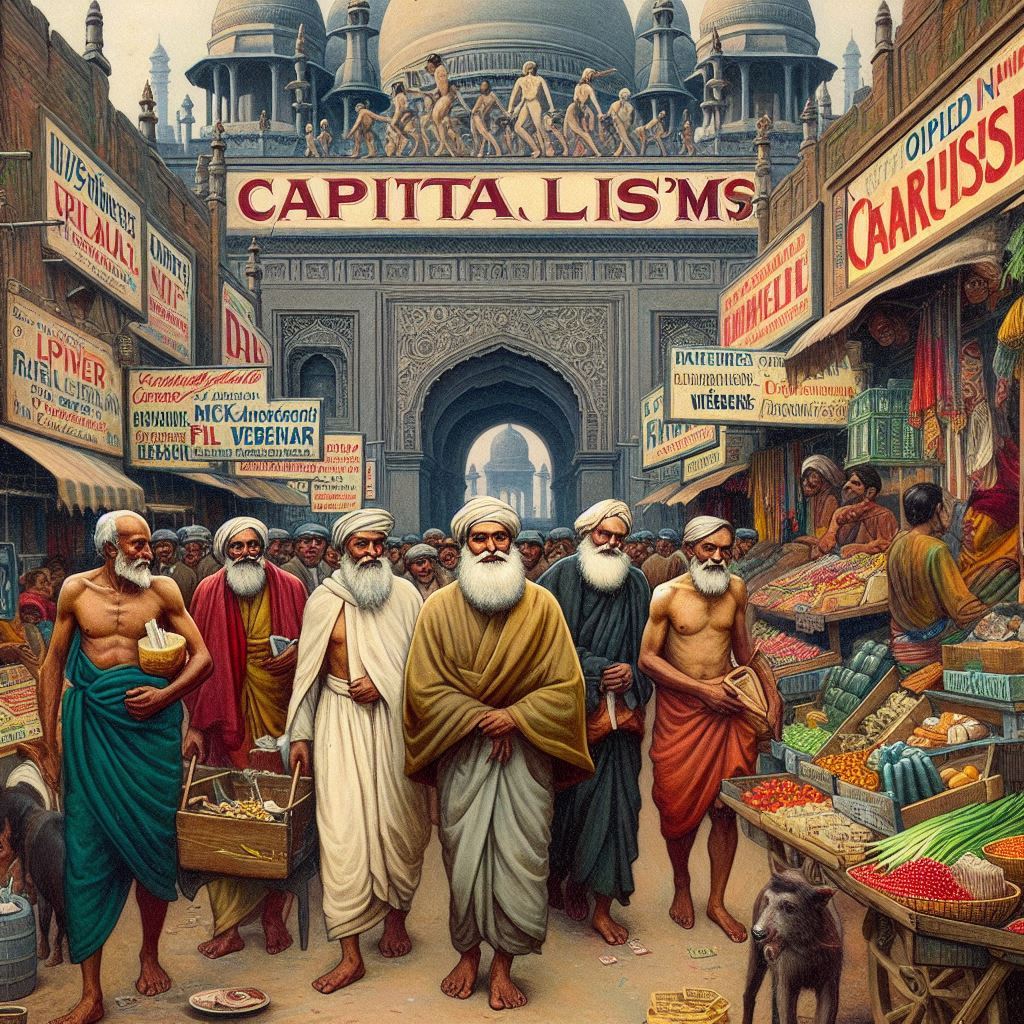
Individual actors own and control property on their own accord, which is mostly market-driven and free of government intervention, according to capitalistic school of thought. This paper tries to envisage the social and economic reasons which have contributed to the rise of capitalism through the prism of Max Weber, Adam Smith and Émile Durkheim. This paper also explains the implications of the theories of these scholars to explain the market-exchange relationship in the Indian subcontinent.
The merchant pays the costs for the goods, hoping to sell the goods at higher prices. The money is again used as the capital. The capital is again used to increase more capital in the market. From purchasing raw materials to converting them to end products and selling it as usable goods, there is turn out of profits. The profits are then again used to start the new ventures and businesses to increase the capital. But, it also involved the Mercantilist policies of restraint, regulations and restrictions (also known as 3R).
The Mercantilist era primarily focused on exporting more goods and commodities while importing fewer, which is believed to be an economic system that maximizes the power of the nation-state (Bassiry & Jones , 1993). Consumers and the emerging middle class were forced to pay inflated prices for domestically created goods that were protected from foreign competition by different protectionist mechanisms, while producers’ interests were benefited. This downgraded the benefits and interests of the consumers. In short, the consumers interests were entirely neglected (Smith, 1976).
This flawed model which is not consumer friendly and anti-market lead to the development of Smith’s Wealth of Nation, which prioritizes the interest of the consumer and is market-driven and an alternative to the socio-political system of the mercantilist (Bassiry & Jones , 1993). Smith envisioned a production system based on consumer requirements, as opposed to mercantilism, which prioritized the producers in a system of centralized (thus authoritarian) economic and political institution (Bassiry & Jones , 1993).
Although, the word “Laissez Faire” was coined by Gournay (Hubernman, 1936), Smith advocated policy of decentralized structure and “Laissez Faire” (without any intervention and economy should be market-driven) instead of centralized structure and a paradigm shift of institution from monopoly market to competitive market(consumer driven).
In this transition from the feudalism type of social and economic structure of society to the emergence of capitalism (after the publication of) by Adam Smith’s ‘Wealth of Nations’ in the year 1776, which is also recognized as the bible of the Businessman’s (Capitalist class) (Hubernman, 1936). Adam Smith is the crucial point which resulted in a shift from Mercantilist model to the capitalism.
Most of the Max Weber works and theories were based on the keen observation. He mostly observed that the big businessman in Europe is from Protestant class. This resulted his comparison of the Protestant with the Capitalist[1]. Weber thought that wherever capitalism exists, religious attachment has the capacity to change the social stratification of the population and establish its occupational structures (Weber, 1905). He characterized the Modern Capitalism, as the wealth is not for the enjoyment, but as the sense of duty to earn more wealth including modern capitalist being individualistic in nature (which resulted in innovation), profit by unlimited accumulation by rational organization of work and the Ethical point[2] (Weber, 1905). Weber derives these ethical points from Benjamin Franklin. He characterized the Protestant (Calvinism)[3] as “God created world for own glory” and not of the priest[4], the doctrine of predestination[5], believed in Asceticism – that is of no material gains which resulted in the self-discipline.
The Protestant Reformation, according to Weber, marked the beginning of the movement from traditionalism to modernity. (Lutheranism, Calvinism). It is in this period, he saw the origin of modern rationality. In this Socio-Economic tussle between Protestant and Catholics, Weber compared Protestant and Capitalism, which resulted in his famous work “Modern Capitalism in Protestant Ethics.” The spirit of gaining profits of Protestant led to the rise in capitalism.
Émile Durkheim another French sociologist coined the term Division of Labour (DOL) and derived it as a social concept. In modern society there is heterogeneity and the differentiation, it is the primitive society (by mechanical solidarity which is based on likeness, norms and values) that holds together. DOL is the splitting of the activities which results in inter-dependence. This concept is used in Capitalist society where a factory system with big organization and division of Labour means a tremendous increase in the production (Capital) (Hubernman, 1936). DOL is increase in Individuality and it maintains the functional interdependence. This concept of Division of Labour is also similar to capitalism, where modern capitalism is individualistic with disciplined labour force. The functional interdependence by Durkheim leads to increase productivity of the labour as it is with time a labourer achieves excellence in his work and performs better in less time. The modern society is the Organic Solidarity (based on the differences) and low collective conscience. It is in a society with more members that they are drawn closer to one another, resulting in struggle and fierce competition, which results in rapid and complete specialization (Durkheim, Division of Labour, 1893), this increases competition in the society which increases profit in Capitalist society. Durkheim also tries to remove the ills of the capitalist society, he broadly compares Italy and Britain, where he observes the suicide rate in Britain was double that of Italy, but in richer and prosperous Denmark the suicide rate was four times higher than that of Italy (Durkheim, Suicide, 1897). Suicide was horrific was result of mental distress created by capitalist theories like Individualism and Excessive Hope[6]. Durkheim so supports religion; he states that religion is as an association which is an essential aspect of society. He cites example of Periodic Table where, Periodic table possess transcendent beauty and a marvel of science but can’t draw a society together, which religion can do (Durkheim, Suicide, 1897). It is through religion and association Émile Durkheim tries to remove the ills of capitalist society and make it prosperous.
Extent to which these theories relate to Indian market-Exchange Relationship.
India being a vast and diverse country, is a heterogenous and caste-ridden society. Due to many restriction it is very complex to state whether the theories of Adam Smith, Émile Durkheim and Max Weber are impactful in Market Exchange Relationship in India. Adam Smith, who encourage free-market approach in the market would be disastrous for the Depressed classes, the government intervention is one of the crucial factors for the upliftment of the Depressed classes. India is also the Patriarchal country, without an intervention of government it would be difficult for the empowerment of the women.
Weber thesis states that Hindu ethic is the hindrance to the capitalist growth in India (Latheef & Ahmed, 1965). To Smith Religion is “relation of all members of a community to a power that has the good of the community at heart.” For Durkheim religion is “unified beliefs and practices” and to the Weber it is “Belief which is either mystic or ascetic in nature”. Indian caste system is rigid structure, it is because of the absence of both economic ethic and rationalization in India, capitalism could not develop. (Latheef & Ahmed, 1965). It is not only religion but also a religion ethics which is important for the capitalism to inhabit. The religion which imposes sanction, does not have any ethics. The socio-cultural hierarchies of civil society are usually mirrored in the markets (Prakash, 2015). Indian labourers did not work hard for the wages, since having more than one’s needs is considered a sin (Latheef & Ahmed, 1965), which hinders the development of the capitalism. The growth of indigenous capitalism in India has been hampered by these anti-economic implications (Latheef & Ahmed, 1965). The ideology of caste creates exclusion both in society and in markets(economy) (Prakash, 2015). The Émile Durkheim Division of Labour is different from[7] India’s Division of Labourers. This division is forced and imposed on the people by the religion. These people are referred as Depressed classes. Only one community ‘Vaisya’[8], was able to trade in the market. Each caste was assigned a occupation, which is forced Labour in the Émile Durkheim theory of Division of Labour. Indian markets are not only limited to class division but are also based on the caste division. This caste division hinders the market-exchange relationship in India. It is through the egalitarian and affirmative policies of government, the market-exchange relationship can be developed. Even though to increase the efficiency of market, theories of these scholars (Adam Smith, Émile Durkheim and Max Weber) can be implicated according to Indian context for market-exchange relationship.
References
Bassiry, G., & Jones , M. (1993). Adam Smith and the Ethics of Contemporary Capitalism. Journal of Business Ethics.
Durkheim, É. (1893). Division of Labour.
Durkheim, É. (1897). Suicide.
Hubernman, L. (1936). Man’s Worldly Goods.
Latheef, & Ahmed, H. (1965). WEBER’S HYPOTHESIS’: “THE HINDU ETHIC AND THE RISE OF CAPITALISM” AND ITS Political Implication in Industrialized India. Indian Journal of Political Science, 12.
Prakash, A. (2015). Dalit Capital: State, Markets and Civil Society in Urban India.
Smith, A. (1976). An Inquiry into the nature and Causes of Wealth of Nations.
Weber, M. (1905). The Protestant Ethic and the Spirit of capitalism.
[1] Weber makes the point of Modern Capitalist in his book Modern Capitalistic Ethic, which means accumulation of capital for its own sake.
[2] Ethics of Modern Capitalism comes from the virtues like Honesty, Integrity.
[3] Calvinism is the branch of the Protestant which follows the tradition set by John Calvin.
[4] Catholics believed mostly in Church and use to give huge offerings to the Church. This resulted in corruption.
[5] People are already chosen for the heaven.
[6] We can also put light on Theory of Alienation by Marx, where a person is alienated in capitalist country, and this alienation causes distress.
[7] The Division of Labourers is coined by Dr. B.R. Ambedkar in the speech annihilation of caste.
[8] Vaisya community was the community in Chaturvana system which can only do trade and business. this trade community is more prevalent in Western Belt of India(Gujarat and Rajasthan).


I have noticed that smart real estate agents all over the place are starting to warm up to FSBO Marketing and advertising. They are noticing that it’s more than merely placing a sign post in the front yard. It’s really regarding building interactions with these dealers who later will become customers. So, if you give your time and efforts to serving these suppliers go it alone : the “Law involving Reciprocity” kicks in. Good blog post.
Via my research, shopping for technology online may be easily expensive, although there are some tips that you can use to help you get the best offers. There are generally ways to locate discount offers that could help make one to buy the best technology products at the cheapest prices. Interesting blog post.
Good day! I know this is somewhat off topic but I was wondering which blog platform are you using for this site? I’m getting tired of WordPress because I’ve had issues with hackers and I’m looking at alternatives for another platform. I would be awesome if you could point me in the direction of a good platform.