Bharat Jodo Yatra 3
|
Getting your Trinity Audio player ready...
|
An unprecedented election of Lok Sabha 2024 was testimony to the battles of narratives, while one party built the narratives of radicalisation, majorly “Batange toh Katenge”, destroying the constitution, and other party on the sole narrative of saving the constitution. The battle was on a pre-poll alliance of the INDIA bloc, endorsed by the Indian National Congress, and the NDA, endorsed by the BJP. The verdict by people was clear action against the narrative of changing the constitution and defeating arrogance. Two journeys of Rahul Gandhi (RaGa). The Bharat Jodo Yatra and the Bharat Jodo Nyay Yatra were not mere marches but historic journeys that altered RaGa’s public image, making him a trusted and reliable leader. The legacy of Gandhi’s family from his great-grandfather J. Nehru, followed by his grandmother,’ Indira Gandhi- Iron Lady of India’, and his father, Rajiv Gandhi, who pioneered in electronics and communication, was carried by Rahul Gandhi, defeating the problem of radicalisation to some extent.
He not only marched to be a leader but also led the campaign on themes of inflation, social cohesion, unity, and saving the constitution. With the efforts of his yatras- involving a more than 4000-kilometer journey from Kanyakumari to Kashmir using slogans like Nafrat Chhodo, Bharat Jodo (Quit hate, unite India). Later, it paved the way for Nyay Yatra, spanning more than 6000 km, raising more radical issues like Manipur riots and unemployment, making the narrative of saving the constitution more prominent. Congress won 99 seats and emerged as a strong, powerful, and the biggest opposition party.
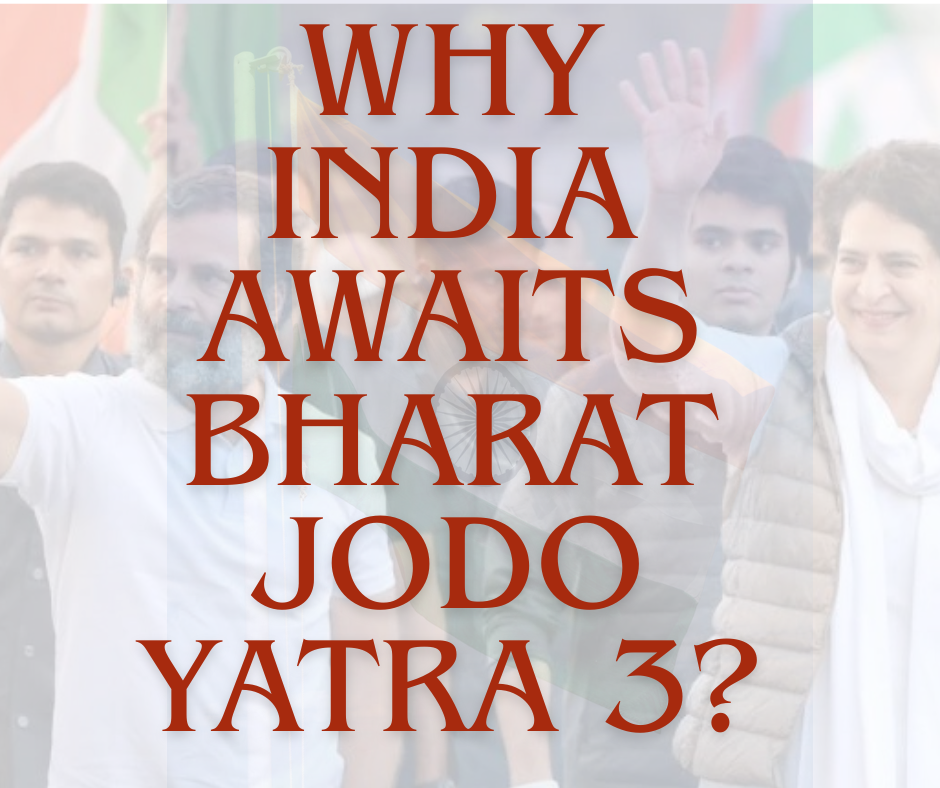
They managed to blow away the caricature of an out-of-touch dynast and substituted it with the image of a strong, compassionate leader willing to hear out the grievances of common Indians. The electoral victory of 2024 was a direct dividend of this exercise. But the recent election outcomes in states such as Maharashtra and Haryana, where Congress did not take advantage of national momentum, are a reminder as much as anything else: a battle was lost, but India’s future is most certainly not. This is a serious and timely question to ask: Is it time to start lacing up the walking shoes for a Bharat Jodo Yatra 3?
The case for the third Yatra is strong, based on the imperative need to solve the twin crises of Indian youth: systemic unemployment and systematic radicalization. These are not independent problems but two faces of the same coin, a poisonous synergy that can destroy the country’s future. A legion of the unemployed is a rich recruitment ground for the commanders of hate. The inability of the government to establish sustainable employment has stranded millions of youth in an ocean of discontent. This economic concern provides the ideal setting for radicalization, as identity-determined, polarizing language is used to divert attention from failures of governance. A jobless society is a vulnerable society to poison. Whereas the initial two Yatras set the tone for this discussion, the third one has to drive it as the predominant, unwavering theme.
It is here that the strategy needs to change. While the first two marches had to do with creating a wide national unity, Bharat Jodo Yatra 3 has to be a focused, strategic action. The suggestion of targeting universities is political brilliance. Universities are the melting pots of India’s future.
Universities are where dreams become reality, ideas are contested, and leaders emerge (like Lalu Prasad, Nitish Kumar, and several others). The universities are a battleground to change the power; for instance, when Jayprakash Narayan started his rallies in Patna, students were the leading force. After that, universities have been ignored by mainstream politicians or targeted by polarizing forces that seek to stifle criticism and critical thought.
Imagining the yatra of RaGa, which stops at prominent universities like Hyderabad, Osmania, BHU, JNU, Patna University, Delhi University, Jadavpur, and other universities (including private universities). Rahul Gandhi can engage in town halls, lectures, or even on common grounds or on the main gates of universities where management denies meetings (as they are mostly influenced by power), offering meaningful discussions with students in addition to public rallies.
This would also help him to reach the first-time voters in the 2029 elections, where students are dealing with their fears regarding job security and academic freedom. By advocating constitutional values and rational discourse in these institutions, he is able to provide a direct antidote to the poison of radicalization that infects so quickly on social media.
In addition, a third Yatra could eloquently speak to the unravelling of India’s federalism. The pilgrimage might be structured to travel through the regions, mainly in Southern and Eastern India, that perceive that their cultural, economic, and political rights are being eroded by an overly centralized union government. It would be an arena for debating matters of fiscal inequality, linguistic domination, and diminution of state sovereignty, reasserting the constitutional vision of India as “a Union of States.” It would extend the significance from bringing people together to bringing states together on a shared quest for their rights.
Critics can take the view that yet another Yatra would be redundant or that efforts should be directed towards conventional, backroom party-raising. But this is a false dichotomy. The Yatra is not an alternative to organizational work; it is its strongest stimulus. It is a distinctive type of mass mobilization that galvanizes the party cadre, highlights local leaders, and stimulates ordinary citizens in a way that nobody can with closed-door sessions. The Yatra is the match that ignites the fire; the party organization is the motor that needs to capture that energy.
The 2024 election outcome demonstrated that Rahul Gandhi’s message connected and that Indians crave an alternative vision. Political momentum, however, is a fleeting object. A Bharat Jodo Yatra 3, youth-oriented, university-based, and committed to the interconnected challenges of unemployment and radicalization, is not merely a political imperative for Congress party politics. It is a national one. The first Yatra was about listening. The second was about justice. The third must be about building the future, one campus, one conversation, one step at a time. It is, indeed, time for the leader to take charge and continue the march.