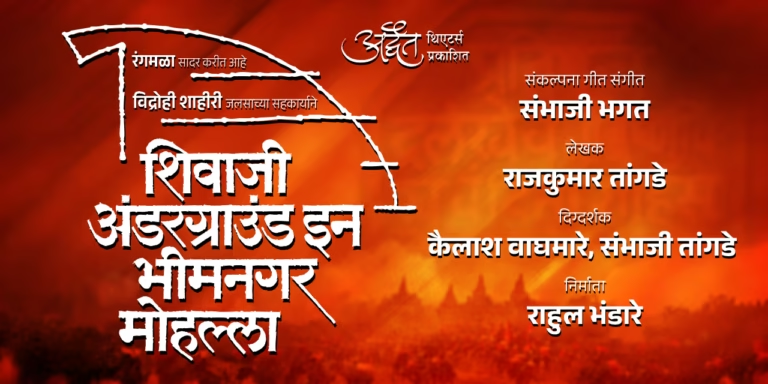

Concept, Songs, Music – Sambhaji Bhagat Writer – Rajkumar Tangade Directors – Kailas Waghmare and Sambhaji Tangade Producer – Rahul Bhandare
|
Getting your Trinity Audio player ready...
|
Indian cinema is witnessing an interesting paradox. Films like Kantara are capturing the masses through their analogy of tribal culture with spiritual traditions. The success of the films reveals a deep public curiosity about identity, heritage and culture. In these rapidly urbanising cities in India, people continue to seek new forms of entertainment beyond commercial cinema and theatres. Among these, theatre has emerged as a space of social critique and collective reflection through the play ‘Shivaji Underground in Bhimnagar Mohalla’, which stands out as a bold and artistic imagination which is reclaiming history from the clutches of communal distortion. The play, conceptualized by Sambhaji Bhagat, written by Rajkumar Tangade, directed by Kailas Waghmare and Sambhaji Tangade, and produced by Rahul Bhandare, has already been performed over 800 times — a testament to its enduring relevance and powerful social resonance.
At the communal times, when the interpretation of history has become the warfare of political ideologies, this play offers a new and refreshing act of resistance. The depiction of history as a source of entertainment in popular media today is not only selective but is also dangerously misleading. History, in its nature, is connected and continuous; currently, it has been fragmented and assembled to serve a narrow ideological purpose. This selective reading of history can be termed as “history of ease”, which is the tendency to extract only the portion of the history which offers emotional comfort and ideological validation and ignore the uncomfortable truths which demand critical engagement.
This distortion of history is visible in Maharashtra, one of the pioneer states where socio-economic reforms are critically progressive through the leaders Chhatrapati Shivaji Maharaj, Jyotiba Phule, Savitribai Phule, Dr Ambedkar, Chhatrapati Shahu Maharaj and many more like Gopal Krishna Gokhale, Ranade, Govind Pansare joining the list. The legacy of the Chhatrapati Shivaji Maharaj has been appropriated and reframed through a communal lens. The Maharaj has been portrayed as a “Hindu King” who fought not against the Mughal Empire as an entity but against Muslims as a religious community, representing a dangerous rewriting of history. Films like Chhava, based on Chhatrapati Sambhaji Maharaj, which reduce complex historical realities into binaries of good and evil, ignoring the pluralism and inclusivity which define the Maratha empire, are replaced by the divisive ideology which fuels mistrust among the communities. This is the kind of historical ease that the play Shivaji Underground in Bhimnagar Mohalla dares to challenge.
The play is a courageous artistic statement. It has been conceived and performed during the time when dissenting voices have been silenced through draconian laws, when freedom of speech is shrinking, and when every word uttered in public is scrutinised and monitored. Against this backdrop, the play’s existence and performance are an act of defiance. It brings humour and historical consciousness woven together to question the communal and dominant narratives about identity, caste and nation.
The play begins with an imagination: Yamraj, god of death, had been ordered to bring Chhatrapati Shivaji Maharaj from Prithvilok (Earth) to Swarglok (Heaven). Yamraj’s task is not merely to bring the Chhatrapati in physical form, but also to bring his thoughts and ideas (to carefully erase the existence). Yamraj, however, succeeds in bringing the Maharaj, but forgets to carry his thoughts and ideas. Realising the blunder, he returns Chhatrapati Shivaji Maharaj to Prithivilok to retrieve his thoughts. Angered by Yamraj’s failure, Indradev cursed Yamraj to remain on Earth until he brings Shivaji Maharaj and his thoughts. More than three centuries pass, and Yamraj continues his search- and finds that Shivaji Maharaj’s ideas now live not in a royal palace but in lanes of Bhimnagar Mohalla among the oppressed and marginalised.
Through this narrative, the play raises questions about the historical significance and politics that act against human consciousness. It continues on asking the critical question about who carries the legacy of Chhatrapati Shivaji Maharaj- the privileged castes who use the name for political and communal mobilisation, or the working class who embody the vision of Shivaji Maharaj of the egalitarian ideas. The play juggles between humour and reflection, maintaining deep intellectual resonance.
There are several dialogues which will make the audience remember the play, but the line which introspects about history is that “history should never be read while sleeping.” This metaphor suggests that history has to be read in consciousness. Selective reading of history promoted by the ruling parties and propagandist filmmakers creates a comfortable illusion rather than understanding. The play revisits the execution of Chhatrapati Sambhaji Maharaj by Aurangzeb, highlighting that the punishments Sambhaji Maharaj received were based on the Manusmriti- a Brahmanical text which enforces hierarchical oppression. The play refuses to interpret the episode in communal terms and exposes the structures of castes and orthodoxy which had shaped historical violence.
It reminds the audience that Shivaji Maharaj cannot and should not be confined to the borders of caste and religion. His army had been remarkably diverse, including Muslims and Dalits. The play highlights that Chhatrapati Shivaji Maharaj didn’t fight only against the Mughals but fought against such an institution which was based on oppression, highlighting that his greatness is not merely in his military achievements but in his vision of justice and dignity. Contemporary politics has sought to weaponise his image by transforming the symbol of unity into the banner of division. This distortion has estranged the real Shivaji Maharaj from his people, turning him into the idol of spectacle rather than a source of ethical and governance inspiration.
The play ends with a contrast between how Shivaji Maharaj is portrayed among the masses as communal and about his legacy. For the politics, Shivaji Maharaj had become a tool as an object of ritualistic reverence and political capital. For the oppressed, Shivaji Maharaj remains a living reality- an idea that illuminates the struggle for self-respect and equality. In the Bhimnagar Mohalla, Shivaji Maharaj’s thoughts are not locked in museums or history textbooks; they are alive in everyday acts of courage and resistance.
The play is more than just the theatre- it is the call to awaken collective consciousness. It stands against the mainstream cinema, which has become a tool of propaganda which enforces the politics of fear and majority triumphalism. Shivaji Underground in Bhimnagar Mohalla is an attempt to restore faith in the form of art. It brings to the conclusion that a normal play can still provoke thoughts, question power, and inspire the masses. Ultimately, this play affirms that the legacy of Shivaji Maharaj belongs not to those who shout the name in hatred, but to those who embody the values of justice, courage and inclusiveness. The play reminds us that Chhatrapati Shivaji Maharaj is not about battles and warfare but is about the inspiring act of people, struggle and the enduring quest for dignity. However strong and forceful the narrative is built around hatred and populism, the true essence of Chhatrapati Shivaji Maharaj, rooted in justice, courage, and social harmony, should continue to guide our collective conscience.
https://in.bookmyshow.com/plays/shivaji-underground-in-bhimnagar-mohalla/ET00455674