|
Getting your Trinity Audio player ready...
|
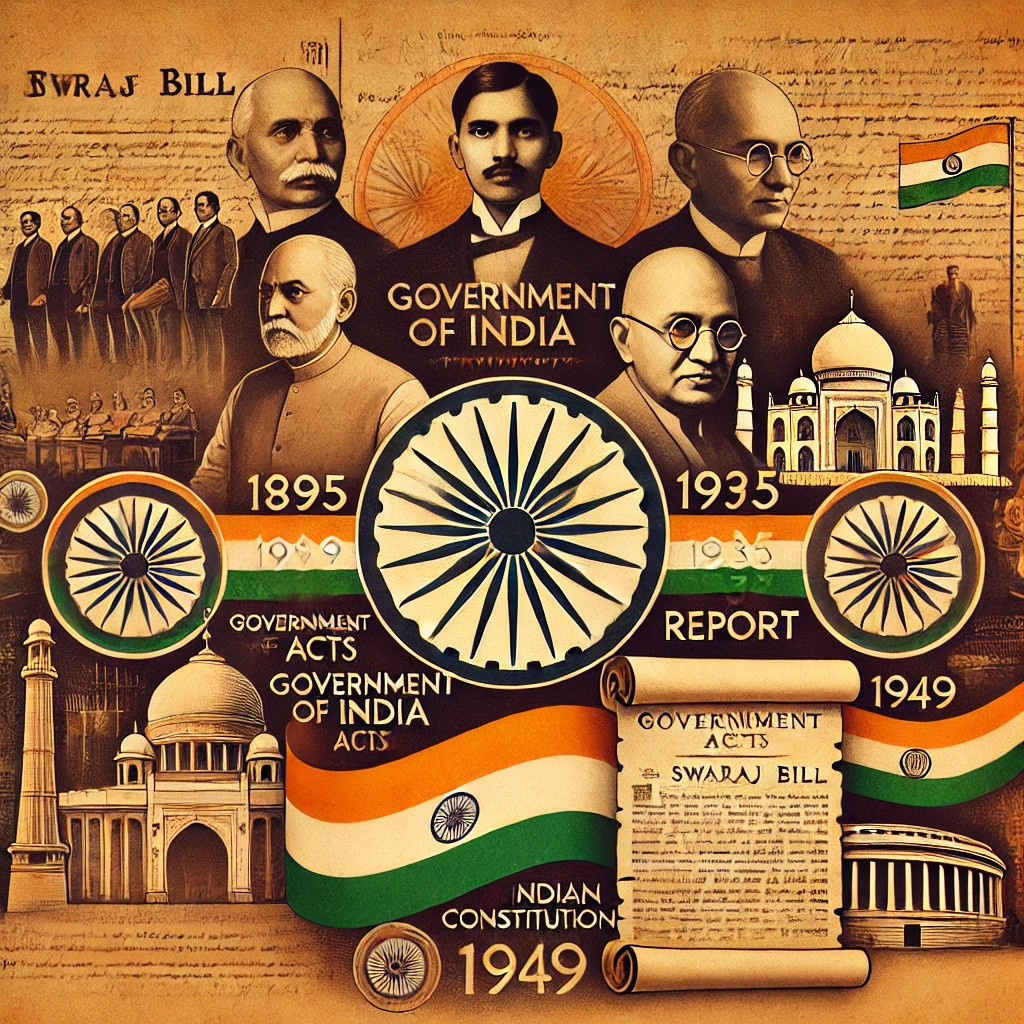
The evolution of India’s constitutional framework reflects a rich tapestry of ideas, debates, and milestones that paved the way for its transition from colonial rule to independence. From the early articulation of Indian aspirations in the Constitution of India Bill (1895) to the landmark Government of India Act (1935), and from the Nehru Report’s vision for a free India to the Karachi Resolution’s emphasis on fundamental rights, each document represents a significant step in the country’s constitutional journey. These historical constitutions, whether drafted by colonial powers, Indian leaders, or reform committees, offer a glimpse into the ideological struggles, political compromises, and social visions that shaped India’s eventual Constitution in 1949. They remain vital sources for understanding India’s quest for self-governance and the principles underpinning its democracy.
The Constitution of India Bill (Unknown, 1895)
The Constitution of India Bill 1895, popularly known as Swaraj Bill, is popularly known to be written by Tilak. It was the first articulation of the constitution by Indians (De 2016). It was the first non-official attempt to draft a constitution for India (Sathe 1975). Not much scholarly has written about the bill.
Indian Councils Act, 1909
The Indian council act popularly known as Morley-Minto reforms (Viceroy and Secretary respectively) was the first steps towards including Indians in the government. The act consisted eight articles and two schedules. The scholars like Gokhale welcomed the provisions of 1909 act (Coupland 1944), and regarded it as the step forward from colonial path to parliamentary self-government. The labour party in Britain had condemned the limited scope of the self-government envisaged by the act (Reid 2016). When, the act was introduced- it brought some representation but by 1915, the act disappointed Indian leaders (Coupland 1944). The idea of separate electorate had got institutional expressions in the act (Jayal 2013). The Lahore session of the congress in 1909 presided by Madan Mohan Malaviya, expressed strong disapproval to the act. Even-though the act brought the representation (Austin, The Indian Constitution: Cornerstone of a Nation 1966), the franchise was extremely restricted (Chiriyankandath 2008). The act gave the electoral representation as the corporatist understanding of the Indian society, representing special interests (De 2016). Whie, the act was to strengthen the British control without anything in return (Reid 2016).
Government of India Act, 1919
Popularly known as Montag-Chelmsford consisted of 47 sections and 5 schedules. During the drafting of the act (including 1935 act), the more emphasis was placed on ensuring community rights rather than distribution of powers (Austin, The Indian Constitution: Cornerstone of a Nation 1966). The provisions represented the movement put forward by Morley-Minto act (Government of India Act, 1909). The act ensured that the power of parliament to fulfil the trust for the good administration and the firm transfer of the authority for a genuine installment of responsible government (Coupland 1944). Thus, the bicameral legislature was developed. Maontague stated this as ‘progressive realization of responsible government in India as an integral part of the British Empire’ (Ilbert and Meston 1923). Madan Mohan Malaviya recognizes the act as liberal, but had criticized (Malaviya, (Year Unknown)) the overall act. Other scholars like Rohit De have somewhat praised the act.
Mrs Besant, dismissed the reforms stating ‘unworthy of England to offer and India to accept’ (Reid 2016). Ambedkar in a lecture to his students in 1923 referred to the Government of India Act as the ‘British Constitution of India’ (Ambedkar, The Constitution of British India (BAWS Volume 12) 1923). The act of 1919 had ambiguity and a mere reflection of India as a colony of the British Empire (Reid 2016). However, the parliamentary system at the provincial level, made politics into the exclusive business of “a class of intermediaries” (Parasher 2023).
Nehru Report
Nehru report was one of the reports which defined the goal of the future constitution in terms of the advancing India’s unity through democratic institutions based on the universal suffrage (Lerner 2016).It remarked an important moment in evolution of India’s nationalism’s relationship to mass politics (Parasher 2023). It was also one of the first constitution of a Free India under the guidance of pandit Motilal Nehru (Lari 1948). Nehru Report in a way is said to be one of the attempt made by Indians to face the difficulties of communalism (Coupland 1944). “On the 6th of December 1946, before entering the House, One of the well-known Members of this House Sir, that the Britishers are not going to leave India and this Constitution will be a second Nehru Report” (Sidhva 1949), one of the member stated in the constituent assembly debate. Some rights in the Nehru report are the reminiscent of the American constitution (Austin, The Idnain Constitution 1966). All the rights which were included in the Nehru Report in predominately liberal constitution appears to be extraordinary (Chandhoke 2017). It was also the exceptional document in terms of social, economic (Jayal 2013) and political rights. Even though Nehru report was criticized by the both Muslims and Hindus (K. Maclean 2017). As it was looked in perspective of the democracy, it was charged as uncritically accepting election in the national legislature (Prasad 1928). Even though, it was also known to be an anti-separatist Manifesto ( Indian Institute Of Applied Political Research 1928).
Karachi Resolution
Karachi congress met the time when Gandhi had called for the truce with British and to negotiate the pact between Viceroy, Lord Irwin, in February 1913 (K. Maclean 2017). The Fundamental Rights Resolution (FRR) remained a significant document which was later incorporated in Fundamental Rights and DPSP (Habiab 1999). The Indian freedom struggle had moved the wave of nationalism, Gandhi had already lead two big movements (non-cooperation and civil disobedience). Earlier proposed bills of rights had expanded to economic and social rights- these rights were culminated in the Resolution of the Fundamental Rights and Economic Changes at the Karachi Session of Congress held in 1921 (De 2016). Mr. Mohammad Tahir in the constituent assembly discussed that there was a provision in Karachi Resolution that key industries and all the mineral resources of the state shall be state controlled, same provision should have been included in DPSP (Tahir 1949(24th November)). Karachi Resolution has also stated that salt manufacturers would be free of duty (Tahir 1949(24th November)). All the rights except right to bear arms were enumerated in Part III and part IV of the 1950 constitution (Shri H.V. Kamath 1948). Both Nehru and Gandhi prominently edited the document and pushed through committees of Congress, to the final stage (K. Maclean 2017). The FFR represents the landmark as it not only led the anti-colonial struggle but heralded a compromise among the range of ideologies like nationalist, liberal and socialist (k. Maclean 2015).
Government of India Act 1935
The Government of India Act, 1935 was in time longest piece of legislation passed in parliament of United Kingdom. The 1935 act brought the stability, it set princes, Muslim League and Congress in architectural opposition to each other (Reid 2016). The importance of Government of India Act 1935, can be understood through constituent assembly debates where the act was referred more than 500 times. Dr B.R. Ambedkar mentioned that through 1935 act, India was not a country with responsible government. In the essay Communal Deadlock and a Way to Solve It, Dr B. R. Ambedkar mentioned that there is no need to form constituent assembly as Constitution of India had already been written out in Government of India Act, 1935. All that is necessary is to delete those sections of the Act, which are inconsistent with Dominion status (Ambedkar, Communal Deadlock and a Way To Solve It 1945). The historian Robert Blake has called the act as ‘one of the great liberal reform measures of modern times’ (Low 1968).
The act greatly expanded the powers of Governor- general, which led Winston Churchill, the war hero to remark that it would arouse Mussolini’s envy. In the time of nationalism, the 1935 act was a spectacular failure (De 2016). Scholar like Andrew Muldoon goes on saying the act “was arguably the most significant turning point in the history of the British administration in India” (Muldoon 2009). Prominent politician like Madan Mohan Malviya said “the act is somewhat democratic in its appearance but completely hallow from inside”, while Jinnah commented it as “thoroughly rotten, fundamentally bad and totally unacceptable.” Then Viceroy (Lord Linlithgow) noted that ‘the 1935 was the best way of maintaining British influence in India,’ Leaders like Nehru only had prelude to greater disunity (Jayal 2013). Nehru called it “all breaks, no engine”. It has also been stated that the Act of 1935 was the joint effort between the factions of politicians from India and the various conservative politician in the UK (Gallagher 1982).
Constitution of Free India : A Draft (M.N. Roy, 1944)
The draft was published in 1944, by M.N. Roy. The draft is compared to the Gandhian constitution of free India and the draft was more of radical and the manifestation of the new India (Jayal 2013). Although the draft was a purely academic interest (Rothermund 1968). M. N. Roy never couched his proposals in the language of an ancient constitution, a premodern republican tradition, or a precapitalist ‘Asian’ economic order (Parasher 2023). Not many scholars have written about the draft constitution of free India by M.N. Roy.
Sapru Committee
The aim of Sapru Committee was to resolve the issues pertaining to minorities. The long 343 pages report contained detailed expositions on various aspects of India’s constitutional future. Norman Brown argued that the Sapru committee report was the most reflective presentation of constitutional issues which has been published (Brown 1946). He expresses the short summary of the report in his works India’s Constitutional issues, where he discusses about the report on main topics like problem of Hindu-Muslim Relations, Pakistan Issues, Federal Structure (Brown 1946). V.P. Menon in his book Transfer of Power claims that the absence of Muslims in the committee may made Muslims hostile to the report (Menon 1957). Sapru Committee also advocated for the strong center (Menon 1957).
Gandhian Constitution for Free India (Shriman Narayan Agarwal, 1946)
The Gandhain constitution was not drafted by Gandhi himself but by Narayan Agarwal. However Gandhi wrote foreword of the draft which said constitution was “based on his study of my writings” and is not “inconsistent with what I would like to stand for.’ The principles like right to obtain a minimum living wage, right to rest and medical freedom were given importance. The draft of Gandhian constitution was based on self-sufficient village panchayat (Jayal 2013). Shriman Narayan in his draft gave a glimpse of Gandhian thought where he states that if democracy is founded on violence it is bound to fail. Decentralization process is the only way to clear violence and coercion (Chapalgaonker 2016). He also suggests that there would be cooperative establishment for dairy, village industries, warehouses for grains (Chapalgaonker 2016). Even though Chapalgaonker have written about the importance of Gandhian thoughts and talks about the Gandhian constitution, he also talks about the villages in danger of extinction, Although he remains a staunch supporter of Gandhian idea. There were also similarities between Radical Democratic Party’s Constitution of Free India and Gandhian constitution, both centered on local citizens assemblies delineating themselves from strong center and federal governments, enshrining the model of recall, referendum and succession (Parasher 2023). Around 1971, the Gandhian constitution was revived by Servants of the People (founded by Lala Lajpat Rai) (G.G. Mirrchandai 1977), and drafted the document “Place of duty in our lives and constitution of India” which was inspired by the Gandhian Constitution. The Part II of the Gandhian constitution was basically based on the direct democracy, and some section includes self-governing village republics (Parasher 2023). Narayan’s constitutional vision was aided by the efforts of writers like Kumarappa and Mashruwala to shape the Gandhian critique of parliament (Parasher 2023). The Narayan’s direct democracy is the link between overcoming the ethos of capitalism and parliamentary government (Parasher 2023). Gandhian constitution lay the foundation of the duty-bound moralities through direct democracy with the vision of the sovereignty which transcends the electoral government.
Draft Constitution of the Republic of India (Socialist Party, 1948)
Jayaprakash Narayan said in the foreword, had “failed to enthuse the country” by its “humdrum work inspired not by the revolutionary mood and aspirations of the people, but by the natural conservatism and timidity of worthy diwans and legal luminaries” broadly emphasizing on the Directive principles (Jayal 2013). Not much has been written on the draft.
The Constitution of India 1949
The draft constitution of 1949, was the end-product of the struggle of all the constitutional makers. Indian constitutional law is fascinating in a way it is creative reinterpretations of the constitution to make it serve changing needs (Choudhary, Khosla and Mehta 2016). The constitution has evolved through partnership of different branches of the government. The constitution contains internal contradictions between various provisions (H. Lerner 2016).
References
Indian Institute Of Applied Political Research. 1928. The Nehru Report An Anti Separetist Manifesto. New Delhi: Michiko & Panjathan.
Ambedkar, B.R. 1923. The Constitution of British India (BAWS Volume 12). Government of Maharashtra.
Ambedkar, B.R. 1945. “COMMUNAL DEADLOCK AND A WAY TO SOLVE IT.” Address delivered at the Session of the All India Scheduled Castes Federation. Bombay (Now Mumbai), May 6.
Austin, Granville . 1966. The Idnain Constitution. London: Oxford.
—. 1966. The Indian Constitution: Cornerstone of a Nation. London: Oxford.
Brown, Norman. 1946. “India’s Constitutional Innues.” Far Eastern Survey (Published by Instuitute of Pacific Relations) 155-158.
Chandhoke, Neera. 2017. The Indian Constitutent Assembly . Taylor & Francis.
Chapalgaonker, Naredra. 2016. Mahatma Gandhi and the Indian Constitution. New York: Routledge.
Chiriyankandath, James. 2008. “Creating a secular state in a religious country’: The debate in the Indian constituent assembly.” Journal of Commonwealth & Comparative Politics, 38:2, 1-24, DOI: 10.1080/14662040008447816 1-24.
Choudhary, Sujit, Madhav Khosla, and Pratap Bhanu Mehta. 2016. “Locating Indian Constitutionalism.” In The Oxford Handbook of Indain Constitution, by Sujit Choudhary, Madhav Khosla and Pratap Bhanu Mehta, 61-87. Oxford: United Kingdom.
Coupland, R. 1944. The Constitutional Problem in India. Oxford University .
De, Rohit. 2016. “Constitutioanl Antecedents.” In The Oxford Handbook of the Indian Constitution, by Sujit Choudhhry , Madhav Khosla and Pratap Bhanu Mehta, 88-118. Oxford: University of Oxford.
G.G. Mirrchandai . 1977. Subverting the Constitution. New Delhi: Ahhinav Publication.
Gallagher, John. 1982. The Decline, Revival and Fall of the British Empire. Cambridge: Cambridge University Press.
Habiab , Irfan. 1999. “The Envisioning of a Nation: A Defence of the Idea of India.” Social Scientist 18-29.
Ilbert, Courtenay, and Meston. 1923. The New Constitution of India. London: University of London.
Jayal, Niraja Gopal. 2013. Citizens and its Discontents An Indian History. Londan: harvard University Press.
Lari, Z.H. 1948. “Constituent Assembly of India Debates.” Constituent Assembly of India Debates- Volume VII Wednesday 8th December 1948. Delhi: Government.
Lerner, Hanah. 2016. “The Indian Founding, a comparative perspective.” In The Oxford Handbook of Indian Constution, by Sujit Choudhary, Madhav Khosla and Pratap Bhanu Mehta, 144-165. Oxford: Oxford University Press.
Low , D.A. 1968. “Sir Tej Bahadur Sapru and the First Round Table Conference.” In Soundings in Modern South Asian Histiory, by D.A. Low, 294-329. Canberra: Australian National University Press.
Maclean, kama. 2015. A Revolutionary History of Interwar India: Violence, Image, Voice and Text. C. Hurst & Co. (Publishers) Ltd.
Maclean, Kama. 2017. “The Fundamental Rights Resolution: Nationalism, Internationalism and Cosmopolitanism in an Interwar Moment.” Comparative Studies in South Asia, Africa and the Middle East, 37,2, August.
Menon, V.P. 1957. Transfer of Power in India. Olive Black Swan .
Muldoon, Andrew. 2009. Empire, Politics and the Creation of the 1935 India Act. Surrey, England: Ashgate Publishing Limited.
Parasher, Tejas. 2023. Radical Democracy in Modern Indian Political Thought. Cambridge: Cambridge University Press.
Prasad, Beni. 1928. A Few Suggestion On The Problem Of Indian Constitution. Allahabad: The Indian Press Ltd.
Reid, Walter. 2016. Keeping The Jewel in the Crown: The British Betrayal of India. Edinburgh: Birlinn Limited.
Rothermund, Dietmar. 1968. “EMANCIPATION OR RE-INTEGRATION (THE POLITICS OF GOPAL KRISHNA GOKHALE AND HERBERT HOPE RISLEY).” In Soundings in Modern South Asian History, by D.A. Low, 131-158. Great Britain: The Camelot Press Ltd., London and Southampton.
Sathe, S.P. 1975. “Fundamental Rights and Directive Principles.” In Constitutional Developments Since Independence, by Indian Law Institute. N.M. Tripathai.
Shri H.V. Kamath. 1948. Constituent Assembly Debates (Proceedings)- Volume VII. Constituent Assembly Debates, New Delhi: Government of India.
Sidhva, R.K. 1949. “CONSTITUENT ASSEMBLY OF INDIA DEBATES (PROCEEDINGS) -Volume XI.” CONSTITUENT ASSEMBLY OF INDIA DEBATES (PROCEEDINGS) -Volume XI (Thurday 17th November 1949. Delhi: Government.
Tahir, Mohammad. 1949(24th November). Constituent Assembly of India Debates (Volume 11). Constituent Assembly of India Debates, New Delhi: Government of India.