|
Getting your Trinity Audio player ready...
|
(For better understanding of the article refer to the blog Privacy in the Digital Age: Unpacking India’s DPDP Bill 2022)
Yuval Harari in recent article in ‘The Economist’ has argued that Artificial Intelligence had hacked the operating system of human civilisation. The AI industry is booming and at its peak; various MNCs are in the race to build their AI to compete. ChatGPT is an artificial intelligence chat box which is trained to follow instructions. Microsoft, Google, the other MNCs are already investing billions of dollars in efficient AI toolboxes. Without formal guidelines from the government the AI can be dangerous not only to economy but also to the humankind.
Fast development of AI due to which global economy has no answer to its regulation. Beyond the European Union’s general data protection laws- there are no fixed and definite regulations. Developing nations like India, which do not have Data protection acts is way behind the race. The Data protection bill will be introduced in the Monsoon session of this year. Hopefully, it gets passed with proper discussion. The Data Protection Bill will undoubtedly not be the solution to artificial intelligence regulation, but it certainly will offer some support in developing AI policies.
There is a great dilemma in the process of regulations, the government wants better self-regulating mechanisms from the industry, but the industry says that it needs an explanation from the government to know what to regulate. The developed nations have already paved the way to regulate AI; in the year 2021, the European Commission published the draft of the Artificial Intelligence Act. In the United States, the Algorithmic Accountability Act of 2022 was introduced in both houses of Congress. Canada has also proposed for Artificial Intelligence and Data Act.
The regulation has to be done so that it will not hamper the innovations but help to innovate and design efficient Artificial Intelligence Systems. The emphasis is on a risk-based, agile, and multistakeholder process rather than a one-size-fits-all obligation or prohibition. The regulation should be guided by the three philosophies of social consciousness- human dignity, diversity and inclusion, and sustainability. The major challenge the regulatory authorities will have is to create fair competition for Artificial Intelligence in the market; the big MNCs will have the upper edge in deciding the pave for AI’s future technologies. The way forward is to have soft regulations, such as non-binding guidelines and standards on the innovation part, whereas have hard regulations, that is, proper codifications of laws for data protection and privacy. Regulations should also be able to manage the risks of Artificial Intelligence so that they will not outcast the human mind in the future. At the same, regulation should also reform and promote the implementation of AI.
Role of International Authorities:
The UN should form autonomous institutions for AI, which should be fair and be a torchbearer to the nation-state to form the policies and development with Artificial Intelligence. Artificial Intelligence can be a tool to reduce inequality between nations. If developed countries have all the innovations, there would be an increase in inequality among the nations. There would also be a wide gap between developed nations and developing nations. Autonomous institutions should disseminate information to all nations. The AI tool will also be used massively in the election procedure- Yuval Noah Harari argued that AI’s role in American presidential elections could produce massive political content, fake stories and scriptures for political discontent resulting in social discontent. One way is to bring the nations of the Non-Aligned movement (NAM) under one umbrella and raise their shared concerns about AI. If not regulated efficiently, the result would be disrupting and devastating the impact would be not on millions but billions of people. If unregulated, AI would be a greater threat than nuclear weapons.
Way forward for India:
India is the most populous nation, and the impact of AI would be wide in India. The Indian government should make the regulation of AI the top priority. The government can make a committee led by Union ministers’ Ministry of Electronics and Information Technology and ‘The Department of Science and Technology’, the nominee of Leader of the Opposition, well-versed lawyers and various individuals from the domain of Artificial Intelligence to formulate the policies and regulation for AI. India should lead the way for regulation and raise concerns in international institutions. At the same time, various states can make a committee to inspect the changes and reforms that AI can bring to their territories. The Centre for Monitoring Indian Economy reports that the unemployment rate in India climbed to 8.11% in April. Unregulated AI may seriously threaten the Indian unemployment rate. The state can also look at the effect of AI on unemployment and skilling the youth for the new generation of Artificial Intelligence. AI should be used as the opportunity to lead the nation and bring the hub of technology to India.
Conclusion:
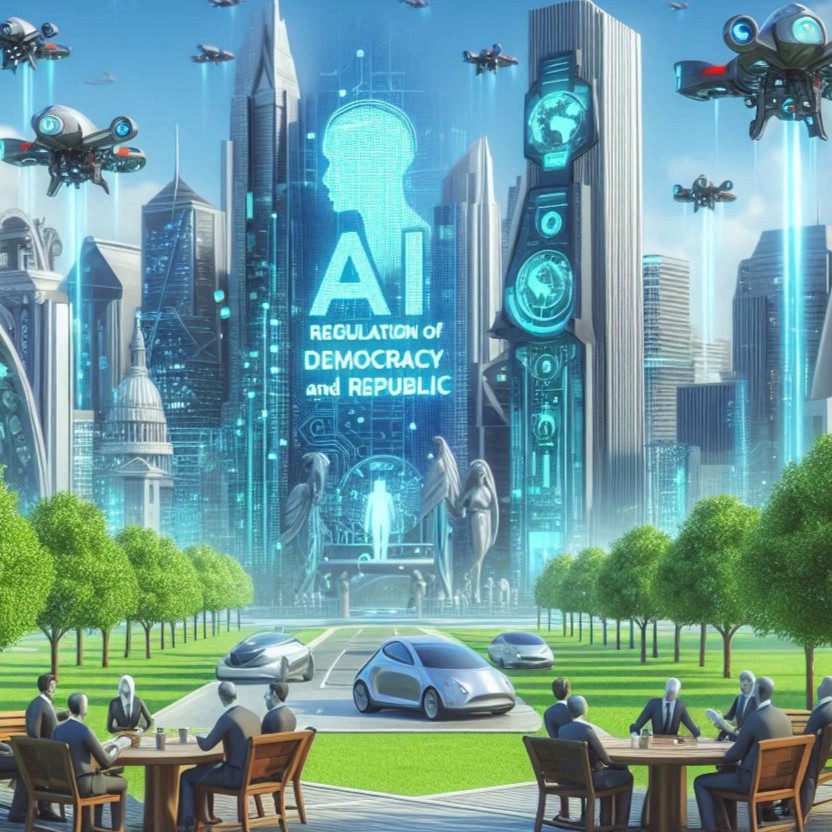
Artificial Intelligence should be the tool to bring political harmony and reduce social and economic inequality rather than bringing social tensions and exploiting the developed states on under-developed. AI should not be rooted as the tool for the ‘technology-colonising’ of developing and under-developed nations. AI should be saved from the crony-capitalism and mercantilism through proper regulations. AI should be used for the lived experience of democracy and constitutional values rather than using AI against those ideas. The way is only through efficient regulations.
(The article was published in Telangana Today on 15th May 2023)