

M. K. Gandhi was not only a freedom fighter but is also known as a social reformer; his Gram Swaraj Idea and idea of Non-Violence have had inspired the world. Gandhi is addressed as the ‘father of the nation’ by another benevolent identity, Subash Chandra Bose. He was called ‘Mahatma’, for the first time by Rabindranath Tagore, whose poems and writings are loved in India and worldwide. The first image of Gandhi that comes to strike is with Charkha in hand, which signified as the emancipation of Indians and their liberation from imperialist forces. This paper critically analyses Gandhi’s idea of Gram Swaraj (Village panchayat).
Gandhi’s Gram Swaraj is not only reflected in the philosophical books or is not limited to the Gandhism school of thought but is an essential aspect in the Indian Constitution- the Directive Principles of State Policy, Part IV of Indian Constitution, which acts as the guide to the state in planning and executing the policies. The Gandhian though which are in Indian Constitution includes Organisation of Village Panchayats (Article 40), promotion of cottage Industries in rural areas (Article 43), Management of Co-operative Societies (Article 43B), Prohibition on the consumption of intoxicating drinks (Article 47) and prohibiting the slaughter of cows and improve their breeds (Article 48). Gandhi claims that the real India is not found in its citizens but in the 7 lakh Villages, emphasising more on community rather than individualism, it remarks that India is considered as the society whose integral and important part is the Village. Gandhi’s thought lies in the self- discipline measures, he points that the cleanliness can be done through their own labour. He also states that everyone is occupied and has nourishing foods, ventilated Dwellings and khadi to cover the body. His belief on Panchayat Raj was so firm that he thought the public opinion will do what violence can never do. In Gandhi’s model of Gram Swaraj there is no such system of punishment, the constituted Panchayat will play the role of Judiciary, Executive and legislative, which give all the powers to the Village Panchayats. His idea states that every village is the republic of its own which has full powers and every village is capable of managing its own affairs.
Gandhi talks about the agriculture without the use of fertilizers and pesticides, he considered organic manure impoverishes the soil, he defines manure as the golden manure which will not only save millions of rupees but will also increase the total yield of gram and pulses. With this, he is clear that using organic manure will also promote cleanliness and it promotes health. The Zero Budget natural farming which consists of important factors like Jeevamrutha, Bijamitra, Acchadana(Mulching), Whapsa is inspired from Gandhi’s model of gram swaraj which is part of organic farming and relies on Agro-ecology. Jayprakash Narayan, contributed to Gandhian School of Thought and to his thinking of local self-governments, argues that representative Political institutions should constituted in such a way that it represents no individual but the communities which shall begin with Village and going outwards embracing wider circles. Gandhiji is a world-preacher whose ideas and sermons are still relevant across the world due to their universality and compassion for all mankind. Gandhi’s ethical ideals in society and politics harmonise the individual’s objective of spiritual growth with his social and political obligations. As a result, it appears to be most relevant and necessary for the development and establishment of a just political society through waking individuals and making them aware of their “true-self,” as well as humanising and socialising them in spiritual and ethical principles.
Critique of Gandhi’s Gram Swaraj:
Gandhi is known as the prophet of an abstract society and an abstract individual as his idea’s mainly consisted of religion and politics and introduced elements of irrationality, conservation and orthodoxy. Religion and politics are two poles apart, mixing them have always created havoc in society.
The architecture of Indian villages is unique in the sense because of its discriminatory nature, it is the casteist society where Maharwada, Mangwada is common, this means that the houses of Mahars and Mangs (Depressed classes) and and other ‘untouchable’ community are either outside the village boundary or they have different locality. With these types of architecture they are not only socially boycotted but are denied the basics rights such as of drinking water from common well, and restricted to graze their cattles from grazing lands. Most of the times they are denied from commodity exchanges for i.e no one would purchase Milk from them. The Gandhi’s idea of gram swaraj gives no right to these communities but instead relies on morality. In Indian Villages Morality is based on the religion and ‘Chaturvarna’ system which is the part of Hindu Religion, eventhough Gandhi believed in the Chaturvarna system.. Gandhi has less emphasis on freedom and equality, but he concentrates on the idea of religion through ‘Ram-Rajya’ and concentrates on the ‘Chaturvarna’ system. Ambedkar was a harsh critique about the Gandhian Gram Swaraj model and the panchayat model citing that Villages are sink of localism, din of ignorance along with communalism and narrow mindedness. Nehru equally critiqued the idea of gram swaraj by stating out-dated and unsuited to modern parliamentary ethos.
One of the biggest oppositions of Gandhi’s Gram Swaraj model was the Panchayat not be elected through ‘one person one vote’ but by through consensus model. There is no possibility that such consensus model would have worked. As every village of India is different, one village may take the consensus of Women into consideration, while other may not. Every village has common religious sanctions on depressed classes, the consensus model would have definitely ruined the Untouchables. Already upper caste has had soaked all the blood from the bodies of untouchables, Gandhi’s model which gives Legislative, Executive and Judiciary powers in the hands of Panchayats based on consensus would have taken the lives and degraded untouchables mere to the condition of starveling.
In Gandhi’s Panchayat Raj giving Legislative powers to Panchayat so that they can work on their own law-making is somewhat absurd in the Indian Parliamentary system, the panchayats in Haryana and western Uttar Pradesh which are recognized as Khap Panchayat, whose head is either hereditary or presided by elder person. It has passed many acts which are inhuman to women, tries to institutionalize honour killing and instances of social boycott is common, giving them power of institution, and transforming this informal institution to formal institution would have been devastating.
Gandhi claims the role of good zamindar with the co-operation among people will improve the conditions of Village without government assistance. The good zamindar is the word itself is vague (it is like calling an evil a good evil), zamindar are hereditary in nature (Chandra, 1988). zamindars have soaked the blood of the Depressed Classes and are ruining by grabbing lands if they are unable to pay the loans, whose interest rates are itself inhuman. Giving zamindars any authority would increase inequality and turn villages into authoritarian rule. In the Harijan column of 1937, Gandhiji suggests the worker to be voluntarily be Bhangi the comment itself is so biased, there is no possibility that privileged classes would be calling themselves ‘Bhangi’ even for a few seconds. In addition, the comment itself is the significance of the division of labourer’s and by making such a statement Gandhi is again signifying the caste-ridden jobs.
Gandhi’s school of thought are not only philosophical but are also novel thoughts in the Indian context. Gandhi is overwhelmed with the morality and idea of self-discipline. “Beware of Gandhi” Dr B.R. Ambedkar warns to all the Depressed Classes, in his Essay Gandhi and his Fast.
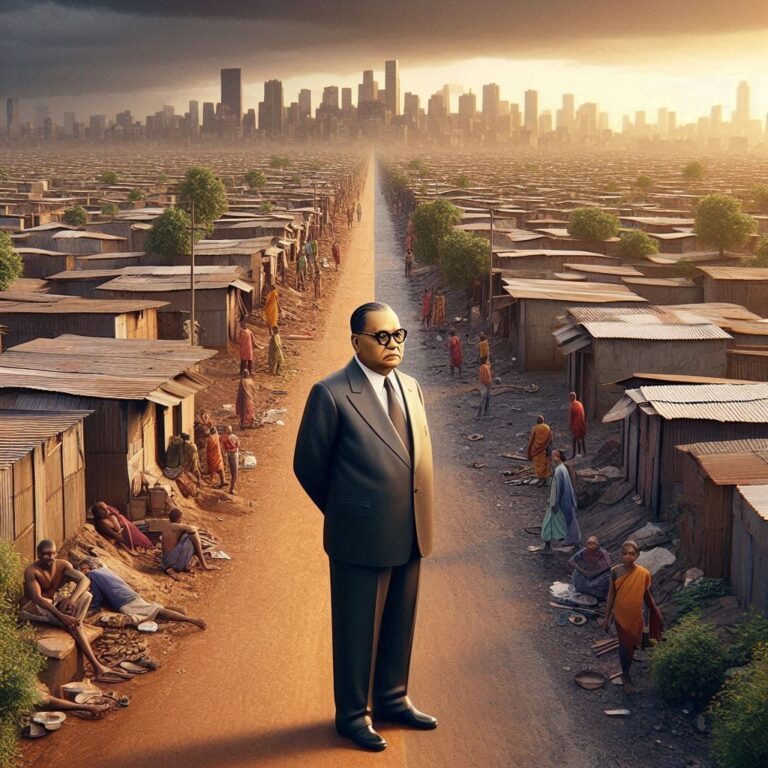
It cannot be denied that real India still lives in rural areas. The pandemic in 2020 in India which has led to the migration of all the labourers from mega-cities, cities and town to villages has shown the reality. But as soon as the pandemic shock were recovering, the nation saw the reverse migration of all the labourers from villages to cities, due to lack of opportunities in the villages. This migration causes over-urbanization, which leads to the development of slums. The harsh reality of the Villages isn’t hidden. The caste issues which make the diversion between lower and upper caste are still evident. The caste hinders equality in every sense; denying the equality of opportunity in every sense. To grow India in the real sense it is important to organize Villages. While speaking to Arjun Rao Gandhi states that “You should become like Ambedkar. You should work for the removal of Untouchability and Caste. Untouchability must go at any cost.” While Dr B.R. Ambedkar was concerned about removing Untouchability by annihilating the caste while Gandhi was more specific about the removal of untouchability rather than caste. Gandhi tried to remove the pain without treating sickness, while Ambedkar treated the sickness. Even though the Gandhian model of gram swaraj has faced harsh criticism and many scholars didn’t agree with his concept of Panchayat, but Gandhi’s stature and prominence are so important in the Indian context that no one dared to ignore him.


This was very helpful, thanks!
Thank you for this well-written and informative article. The practical tips you’ve shared are going to be very useful for my work.