|
Getting your Trinity Audio player ready...
|
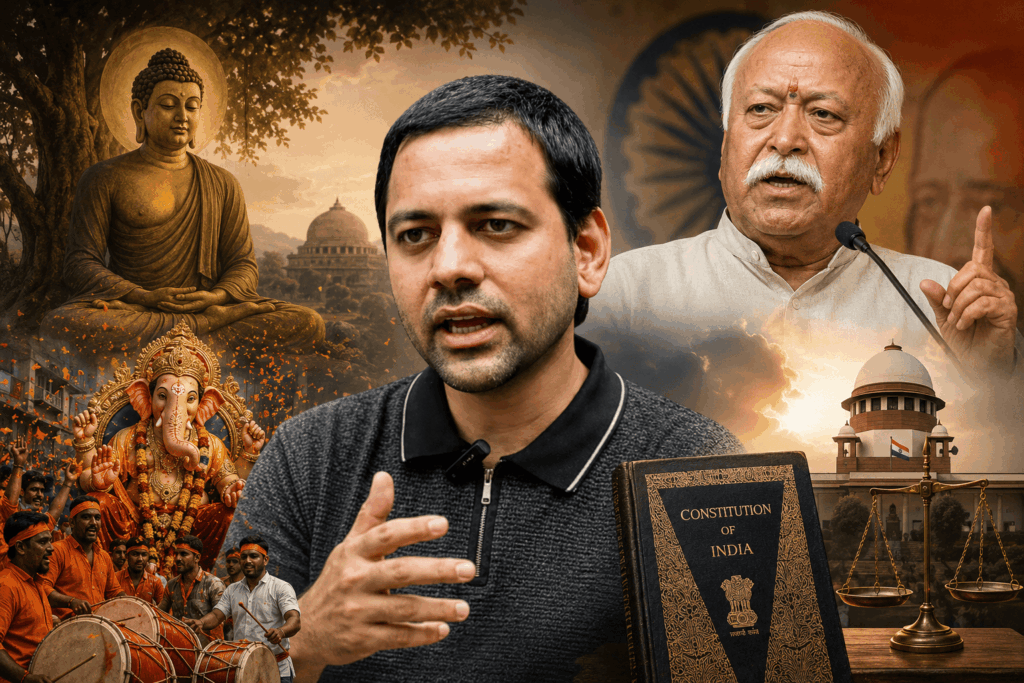
A slap delivered in the middle of a media interaction can be dismissed as an act of individual aggression. But when the person being attacked is speaking about the excessive use of DJs and loudspeakers during a religious festival, the incident begins to acquire a larger meaning. On September 3, activist Vidyanand Bapat was assaulted in Pune while speaking to the media about noise during Ganeshotsav. The alleged attacker, Santosh Chavan, was detained by the police, and the incident drew condemnation from political leaders and the police administration. Bapat has maintained that his campaign is against excessive noise and not against Ganeshotsav itself.
The disturbing part is not merely that a disagreement became physical. It is that a question about the manner of celebrating a religion can so quickly be interpreted as an attack on the religion itself.
This is where Bapat’s case becomes more interesting. A Brahmin questioning the excesses of a religious celebration presents an unusual contradiction in a society where Brahmanical traditions have historically occupied an important position in defining ritual authority. One might expect such a question to produce an internal debate about the necessity of ritual, the limits of public celebration and the meaning of tradition. Instead, the defence of the practice can come from communities that historically stood outside that ritual authority.
The reversal tells us something important about contemporary Hindu identity.
Religion is increasingly becoming not only a matter of belief but also a language of belonging.
The expansion of Hindutva over the past several decades has been important precisely because it has not remained confined to upper-caste Hindu society. The political mobilisation around the Ram Janmabhoomi movement brought large sections of OBC society into a common Hindu political imagination. Caste identities did not disappear. Rather, they were placed within a larger religious identity that promised a different kind of social recognition.
This produces a curious paradox.
A community that has historically experienced social hierarchy can find a new form of political and cultural assertion through Hindu identity. The festival, the procession, the religious symbol and the public celebration become ways of saying: we belong here too.
This can explain why a ritual that a Brahmin may regard as unnecessary can nevertheless be defended passionately by an OBC devotee. The disagreement is no longer about the ritual itself. It is about ownership.
The question becomes: who has the right to define what Hinduism is?
Historically, religious authority was strongly associated with priests, texts and Brahmanical institutions. Today, that authority is increasingly being democratised or perhaps politicised. The community itself can become the final authority. A practice becomes legitimate not because a religious scholar declares it necessary, but because thousands of people identify it as part of their collective identity.
Once this happens, criticism becomes difficult.
To question the volume of a loudspeaker can be presented as questioning the festival. To question a procession can be presented as questioning tradition. To question ritual excess can be presented as an attack on Hinduism.
The distinction between criticising a practice and rejecting a religion begins to disappear.
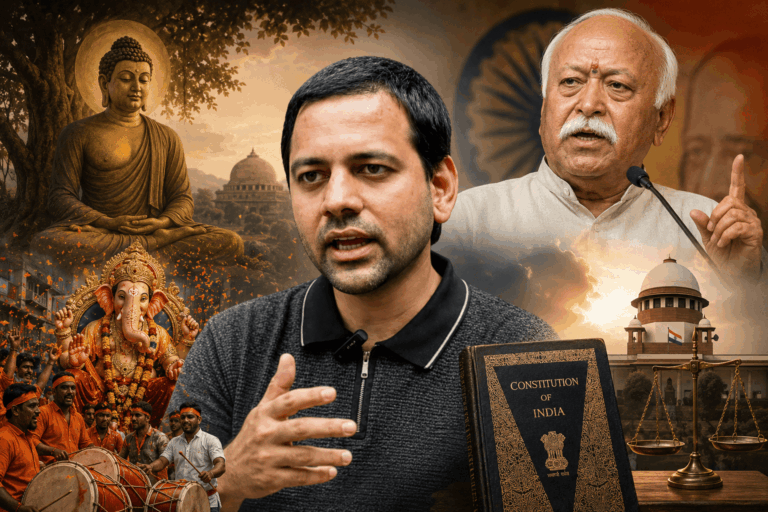
This makes the recent words of RSS chief Mohan Bhagwat particularly striking. Speaking in New York on August 29, Bhagwat presented India as a civilisation whose destiny is to demonstrate that unity and diversity can coexist. He spoke of the oneness of humanity and argued that a Hindu who wants Muslims driven out of India cannot remain a Hindu.
Coming from the head of the Rashtriya Swayamsevak Sangh, an organisation at the centre of India’s Hindu nationalist movement, such language is striking. It is even more striking when placed alongside the broader invocation of Buddha and India’s civilisational traditions by Hindu nationalist leaders.
Bhagwat’s formulation deserves neither automatic celebration nor automatic dismissal. It raises a more fundamental question: what happens when a political movement historically associated with Hindu consolidation begins presenting Hindu civilisation through the language of pluralism, diversity, humanity and Buddha?
Perhaps Hindu identity is expanding to accommodate a wider range of Indian traditions. Or perhaps diverse traditions are being incorporated into a broader cultural definition of Hindu civilisation. Either way, the boundaries of the identity are changing.
And that change has a relationship with the growing participation of OBC communities in Hindu political mobilisation.
There is a deeper irony here. The same society in which sections of traditionally dominant communities can question ritual excess is also witnessing increasingly strong defence of religious identity among communities that have historically sought greater social recognition. The result is not the disappearance of caste but its reorganisation.
The old hierarchy does not necessarily vanish. It can be overlaid with a new common identity.
This is where the idea of acceptance becomes important.
If joining the larger Hindu fold provides a community with a sense of dignity, visibility and political recognition, then defending the symbols of that fold becomes an act of self-assertion. The person defending the loud procession may not simply be defending noise. He may be defending his place within a community that he increasingly sees as his own.
That is why the physical assault on Bapat is more troubling than the act itself. Violence cannot be justified by religious sentiment. Disagreement must remain disagreement. The Constitution cannot mean much if citizens are free to speak only when their speech does not disturb a dominant sentiment.
This is where Narendra Dabholkar’s legacy becomes relevant. Dabholkar devoted his life to challenging superstition and promoting rational thought before being assassinated in 2013. His death demonstrated the dangerous distance between religious belief and intolerance of questioning.
A democratic society must preserve the right to question precisely because religion, like every other social institution, is capable of reform.
There is also a material dimension to this transformation that is often overlooked.
India is becoming more educated, more urban and more economically aspirational. Families are spending on education, professional advancement, housing and the future of their children. Yet religious celebrations can simultaneously demand enormous amounts of money, time and collective energy. Decorations, sound systems, processions and community events create expenditure that is often accompanied by social pressure to participate and contribute.
The cost of festivals is therefore not simply financial. It is also the cost of attention, time, sleep, public space and social energy.
Festivals can undoubtedly create community and preserve culture. The question is what happens when celebration becomes competition—when the size of a procession, the volume of its sound or the grandeur of its decoration becomes a measure of community strength.
At that point, restraint can itself appear like weakness.
This is the central contradiction of the present moment. India is simultaneously becoming more modern and more intensely invested in visible forms of collective identity. Education and economic mobility do not automatically reduce the need for belonging. Sometimes they create new forms of it.
The challenge, therefore, is not to choose between religion and modernity. It is to ask whether religious identity can coexist with constitutional liberty.
Can a person celebrate Ganeshotsav and another person object to excessive noise?
Can a Hindu question a Hindu ritual without being accused of betraying Hinduism?
Can an OBC community claim full ownership of Hindu identity without having to prove its belonging by defending every practice associated with it?
When the RSS speak of Buddha, diversity and universal humanity while Indian society continues to negotiate the boundaries of Hindu identity?
And can India preserve the distinction between faith and compulsion, participation and conformity, belonging and obedience?
These questions matter more than the slap itself.
Because the real danger is not that people are becoming religious. Nor is it that communities are finding pride in their traditions. The danger begins when religious belonging becomes a test that citizens must repeatedly pass.
A constitutional democracy should not ask people to prove their faith by defending every ritual, or prove their community loyalty by silencing dissent.
The freedom to celebrate is important.
But so is the freedom to question the celebration.
And perhaps the real measure of India’s religious freedom will not be how loudly a community can celebrate its faith, but how safely a citizen can ask whether that celebration has gone too far.