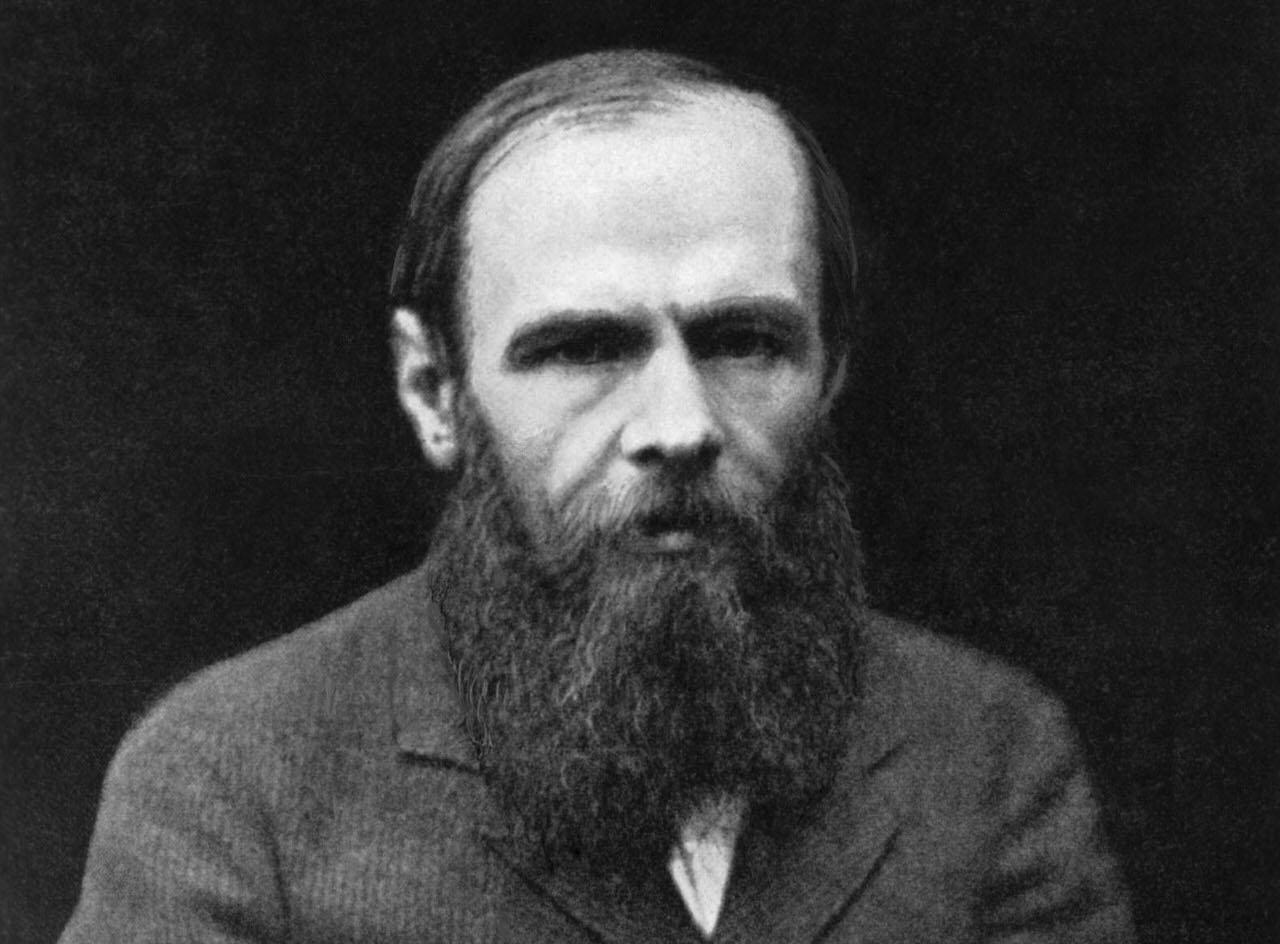
Fyodor Dostoevsky born in Moscow in 1821, a Russian novelist whose works are not resplendent with sunshine and poetry, yet they cannot be accused of despair. We can see a glimmering of freedom, spiritual independence, which is our birthright. Dostoevsky a great Russian, Dostoevsky the Psychologist, Dostoevsky the prophet, Dostoevsky told us clearly that today’s canonized law of nature will tomorrow be broken down into something smaller. He tells us there are no ultimate laws, no primary causes: when you think you have pinned down a fundamental law of nature you will soon find another one hidden behind it, and another behind that. His ramblings culminate in a range of paradoxes that seemed nonsensical. The best for example is the denial of the arithmetic equation 2 X 2 = 4 which is inhuman, inaccurate, useless, stultifying, and simply wrong. By contrast 2 X 2 = 5 is inspiring, intelligent, useful, uplifting and true. In terms of psychology, Dostoevsky was a true innovator. His interesting characters in his books reflect how he used his ideas on human motivation(often subconscious), perversity, masochistic delight, and particularly the significance of dreams. His fiction foreshadows twentieth-century theory. His major works include Crime and Punishment, The Karamazov Brothers, and Notes from Underground.
Majorly the book ‘The Karamazov Brothers ‘ Dostoevsky talks about money, sex, and violence in the materialistic world- atheism and skepticism in the world and belief in spiritualism, the existence of God at the same time. In the book Karamazov where Fydor Karamazov(father) has three sons: body, mind, and spirit. The Mitya(Dimitri) shows sensual pleasure, passion and sees everything materialistically. Ivan’s religious nihilism, an atheist and most rational. Alyosha being spiritual certitude. The book clearly defines the nature of fatherhood- the elders and their duties. Dostoevsky is himself an institution that rectifies and proves the nature of humans in every sense. Each character can be compared and contrasted with the present.
The Karamazov Brothers reflect the nature of Dostoevsky, at a point you can read the author is confused in the ideologies Alyosha who follows Father(priest) Zossima who is also the religious head of the society reflects how Dostoevsky considers religion as an important aspect. Ivan who is an atheist has counterarguments. This reflects Dostoevsky’s confusing nature, he brings proper debate and discussions. Both characters Alyosha and Ivan make valuable arguments. They both debate and discuss the concept of God. Mitya(Dimitri) has been charged with the murder of his father. The materialistic world believes Dimitri is a murderer. But when we analyze the character and have the marvelous journey of reading, Dimitri seems innocent- but he is convicted. The central idea ‘Better acquit ten guilty men than punish one innocent man’ doesn’t seem valuable in this century because it had been a core principle of every democracy- but this idea in the middle of the 19th century is provoking, intelligent and enlightening. This idea was dangerous in Tsar’s Russia.
Dostoevsky’s works disclose the provisional and unstable nature of contemporary existence which has lost both the spiritual certainty and faith in the power of reason which sustained man in the earlier ages. The Karamazov brothers is a blend of entertainment, psychology, mystery. The best thing about the story is, whatever ideologies there are, whatever materialistic people are – how characters debate on the presence of God. How atheism is relevant. which country is best- The story ends without any clear ideology. it is a book where no one wins, Is Dimitri relevant- does he deserve punishment- Ivan being an atheist where is stands at last is not clear- and this confusion is beautiful. The unclear stand is relevant. the open-end book is astounding. This shows the unclear things can be beautiful too.The book ends with the phrase ‘Hurrah for Karamazov’ but it is ‘Hurrah for Dostoevsky’.
Manish Narwade